
Dental implants
Dental implants in midtown Sacramento
The closest thing modern dentistry has to a natural tooth. 3D guided placement, custom crown work, and full arch options, planned and delivered by the same team that knows your history.
What a dental implant is
A dental implant is a small titanium post that takes the place of a missing tooth root. It is placed into the jawbone in a quick in office surgical procedure, then left to heal for a few months as the bone fuses around it. Once the bone has fully integrated with the implant, a custom abutment and crown are attached on top, giving you a replacement tooth that you can chew on, brush, and smile with the same way you would a natural one.
Implants are considered the standard of care for replacing missing teeth in modern dentistry because they are the only restoration that replaces the root. Bridges and dentures sit on top of the gum, but only an implant transmits chewing forces into the bone the way a natural root does, which is why implants preserve bone over the long term and other replacements do not.
Why implants beat the alternatives
When a tooth is missing, you have four practical options: do nothing, place a fixed bridge, wear a removable partial, or get an implant. Each has its place. Implants are the most expensive up front and the slowest to complete, and they are still the best choice in most situations. Here is why.
- They preserve bone. The bone around a missing tooth begins to shrink within months. Implants stop that loss because they are loaded the way a natural root is loaded. Bridges and dentures do not.
- They do not damage neighboring teeth. A traditional bridge requires reshaping the two healthy teeth on either side of the gap. An implant stands on its own.
- They function like a real tooth. No clipping, no slipping, no soaking. You brush and floss it like the rest of your mouth.
- They have higher long term success rates than fixed bridges, partial dentures, and full dentures.
- They cannot get cavities. The implant itself is titanium and the crown is ceramic, so neither can decay. The gum around it still needs care, and peri implant disease is a real condition, but it is preventable with good hygiene.
- They can replace anything from one tooth to a full arch. Two to four implants can support a fixed full arch bridge that looks and feels like real teeth.
Single, multiple, and full arch options
Implant dentistry covers a broad range of cases. The right approach depends on how many teeth you are missing and the condition of your bone and gums.
- Single tooth implant. One implant and one crown. The most common case we see and the most predictable.
- Multiple single implants. Two or three individual implants for two or three missing teeth that are not next to each other.
- Implant supported bridge. Two implants supporting a bridge that replaces three or four adjacent teeth.
- Implant supported denture. Two to four implants that anchor a removable denture, eliminating slipping and dramatically improving chewing power.
- Full arch fixed bridge. Four to six implants supporting a permanent, non removable full arch of teeth, sometimes called All on 4 or All on 6. Life changing for patients who have lost most or all of their teeth.
- Implant with same day extraction. When a failing tooth needs to come out, we can sometimes place the implant the same day, which saves a healing cycle.
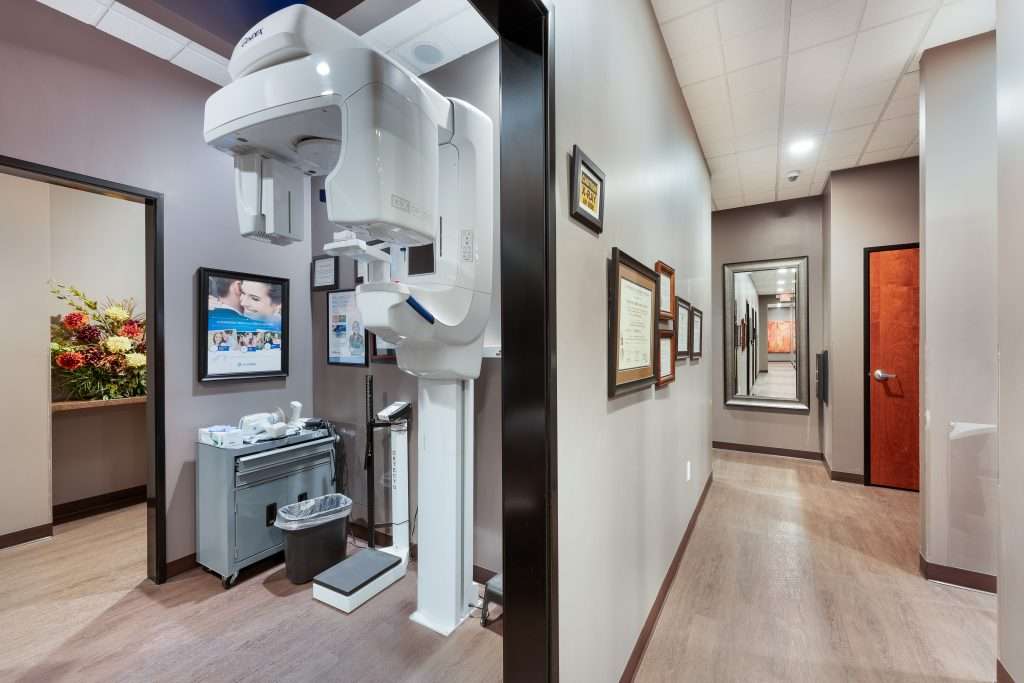
Every case starts with a consultation, a 3D cone beam CT scan, and a digital plan tailored to your mouth. There is no single recipe.
The implant process step by step
- Consultation and 3D scan. We take a low dose CBCT scan to see your bone in three dimensions, evaluate nerve and sinus position, and plan the exact placement of the implant before you sit in the surgical chair.
- Treatment planning. We review the plan with you, discuss timing, talk through extraction or grafting if needed, walk through the cost, and answer questions. You leave with a written plan and estimate.
- Site preparation if needed. Failing tooth removal, bone grafting, or sinus lift procedures if your case requires them. Some cases skip this step entirely.
- Implant placement. A short in office surgical visit under local anesthetic, with sedation if requested. The implant is placed precisely according to your digital plan, often with a custom surgical guide. Most patients are surprised at how easy it is.
- Healing and integration. The implant fuses to the bone over the next two to four months. You wear a temporary if needed, brush and floss normally, and come back for routine cleanings.
- Final restoration. Once integration is complete, we attach a custom abutment and a final ceramic crown shaded to match your natural teeth.
- Maintenance. Routine cleanings every six months and good home care keep the gum tissue around your implant healthy for the long term.
Who is a good candidate
Most adults with missing teeth are candidates. The two main requirements are healthy gums and enough bone to support the implant. Several factors can affect candidacy without being absolute disqualifiers:
- Bone volume. If you have lost significant bone, grafting can rebuild the site over a few months.
- Gum health. Active gum disease needs to be treated first. Our in house periodontist handles this in the same building. Read more.
- Diabetes. Well controlled diabetes is fine. Poorly controlled diabetes affects healing and increases failure risk.
- Smoking. Smoking measurably increases the risk of implant failure, especially during healing. We will talk through this honestly.
- Certain medications, especially IV bisphosphonates and some antiresorptive drugs, can affect healing and require careful planning.
We do not turn patients away without a real conversation. The honest answer is almost always yes, and the only way to know for sure is a consultation and a scan.
Recovery and long term care
Recovery from implant placement is usually milder than patients expect. Most people are back to normal activities the next day or two. Some swelling, mild soreness, and minor bruising for a few days is typical and managed with ice and over the counter pain medication. We provide written aftercare instructions and follow up to make sure you are healing well.
For long term success, treat your implant the way you treat your natural teeth. Brush twice a day, floss daily including under the crown, and come in for routine cleanings every six months. The biggest threat to long term implant health is peri implantitis, which is essentially gum disease around an implant. Good home care and regular hygiene visits prevent it.
Detailed aftercare guidance is on our implant post op instructions page.
Cost, financing, and insurance
Implant cost varies based on the complexity of your case. A straightforward single tooth implant with a crown is one number. A full arch fixed bridge is several times that. Cases that include extractions, grafting, or sinus lifts cost more than cases that do not. We will give you a written estimate before any work begins so there are no surprises.
Many dental insurance plans now cover at least a portion of implant treatment, often the crown and sometimes the implant itself. We verify benefits in advance and file claims directly. For self pay patients and balances after insurance, we offer Cherry financing, with your exact rate and terms shown before you sign. Cost should not be the reason you live with a missing tooth, and we will work with you to find a path that fits.
See accepted insurance plans, view financing options, or request your implant consultation online.
FAQ
Frequently asked questions
The most common questions we get from patients considering dental implants.
What is a dental implant and how does it work?
A dental implant is a small titanium post that is placed into the jawbone to act as an artificial tooth root. Over the next few months, the bone fuses to the implant in a process called osseointegration. Once it has fully integrated, a custom abutment and crown are attached on top, giving you a replacement tooth that looks, feels, and functions like a natural one.
Who is a good candidate for dental implants?
Most adults missing one or more teeth are candidates. The main requirements are healthy gums and enough bone volume to support the implant. If bone is thin or has shrunk after a long period of tooth loss, bone grafting can prepare the site. Uncontrolled diabetes, heavy smoking, certain medications like IV bisphosphonates, and active gum disease can affect candidacy and may require additional planning.
How long do implants last?
Dental implants are designed as a long term solution and frequently last decades or a lifetime with good home care and regular cleanings. Published research generally reports implant survival rates above 95% at 10 years, depending on patient factors and case complexity. The crown on top of the implant may need replacement at some point, similar to any crown, but the implant itself usually does not.
Is implant placement painful?
The procedure is done under local anesthetic and most patients describe it as easier than they expected. Many compare it to a routine extraction. Mild soreness for two to four days afterward is normal and usually well controlled with over the counter pain relievers. Oral conscious sedation is available for patients who want a deeper level of comfort.
How long does the whole process take?
From consultation to final crown, most single tooth implant cases take three to six months. Bone grafting, sinus lifts, or full arch cases can extend the timeline. Most of that time is healing and integration, not appointments. You typically have only a handful of office visits across the entire treatment.
How much do implants cost in Sacramento?
The cost varies significantly based on whether you need an extraction, bone grafting, the number of implants, and the type of final restoration. A single implant case with a crown is one number; a full arch is another. We provide a written treatment plan and estimate before any work begins, and we offer financing through Cherry, with your exact rate and terms shown before you sign.
Get started
Ready to replace a missing tooth the right way?
Most implant consultations include a 3D scan, a written plan, and clear pricing. You leave with answers, not a sales pitch.