
Laser dentistry
Laser dental treatment
Dental lasers offer less invasive periodontal therapy, more thorough root canal disinfection, and faster healing for select procedures. We use them where the evidence supports real clinical benefit, not as a marketing gimmick.
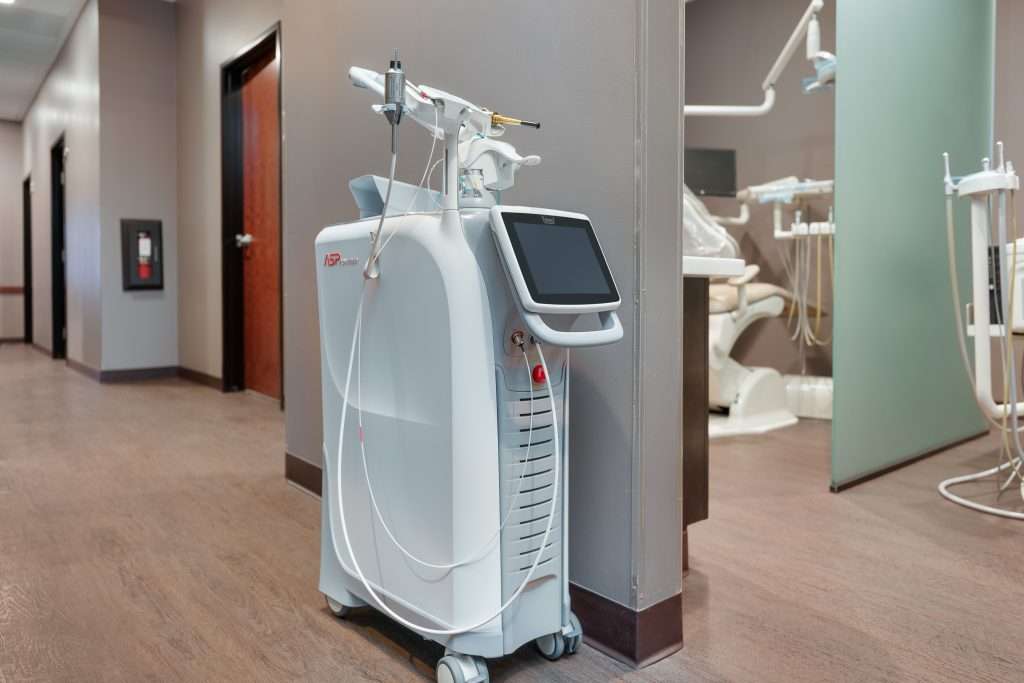
What laser dentistry actually is
A dental laser is a focused beam of light energy delivered at a specific wavelength tuned to interact with a particular target in the mouth. Different wavelengths are absorbed differently by water, pigment, bone, and soft tissue, which is what allows a laser to cut gum tissue without damaging enamel, or disinfect a root canal without harming the surrounding dentin. Laser dentistry is not one procedure. It is a category of technologies that, used correctly, can provide real clinical advantages over traditional methods for specific applications.
We invested in professional dental laser systems because the evidence for certain applications is strong enough to justify the cost. We are not laser maximalists and we do not use lasers for procedures where the traditional approach is equally good or better. Where they genuinely help, we use them. That philosophy is how we try to approach any new technology.
TwinLight periodontal therapy
TwinLight is a dual wavelength laser protocol from Fotona designed specifically for periodontal disease treatment. It combines two lasers with different tissue interactions: one that removes diseased soft tissue and kills bacteria in periodontal pockets, and one that stimulates the collagen rich tissue at the base of the pocket to heal, reattach, and in some cases regenerate. The combined effect is a less invasive way to address early to moderate periodontitis with significantly less post operative discomfort than traditional gum surgery.
Periodontal disease affects a majority of American adults at some point in life and is the leading cause of adult tooth loss. Early stages respond well to routine cleaning and improved home care. Once the disease has moved into deeper pockets and begun causing bone loss, traditional therapy has involved scaling and root planing to physically remove the bacteria and tartar, followed in advanced cases by surgical pocket reduction with a scalpel. The surgical approach works but it is invasive, involves sutures and several days of recovery, and is not something patients look forward to.
TwinLight gives us a middle option. For moderate cases, we combine traditional scaling and root planing with laser bacterial reduction and tissue stimulation to achieve deeper disinfection and faster healing than scaling alone. For select advanced cases, laser assisted periodontal therapy can serve as a less invasive alternative to traditional flap surgery. Patients report less bleeding, less swelling, less need for narcotic pain management, and a faster return to normal function.
Periodontal treatment at our office is overseen by Dr. Reem Atout, our board certified periodontist, which gives us a specialist level of judgment about when laser therapy is the right tool and when traditional surgery is still the right call. Read more on our gum disease page.
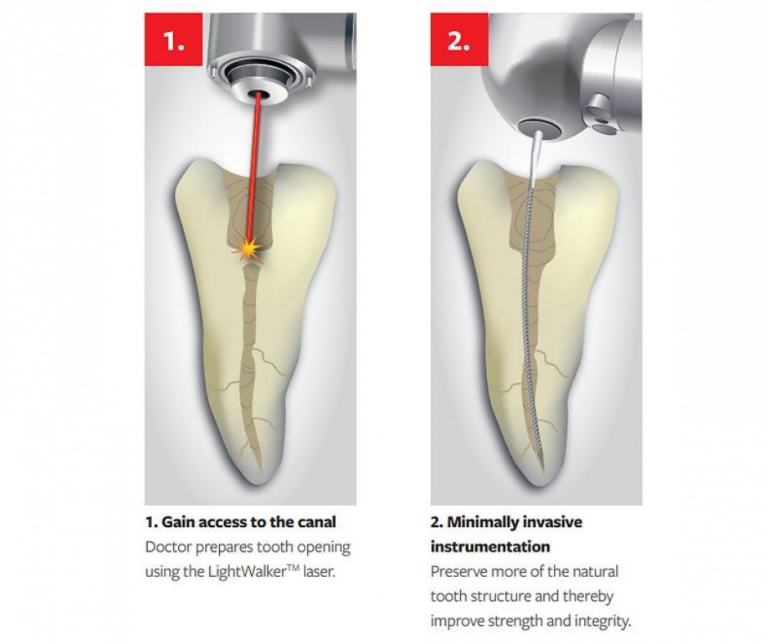
PIPS and SWEEPS laser assisted root canal disinfection
Root canal therapy is traditionally done by mechanically cleaning the inside of a tooth with files and flushing it with antimicrobial solutions. The challenge is that root canal systems are not simple single channels. They branch into dozens of small accessory canals and lateral branches that traditional files physically cannot reach. Bacteria hiding in those branches are a common reason a root canal ultimately fails and requires retreatment.
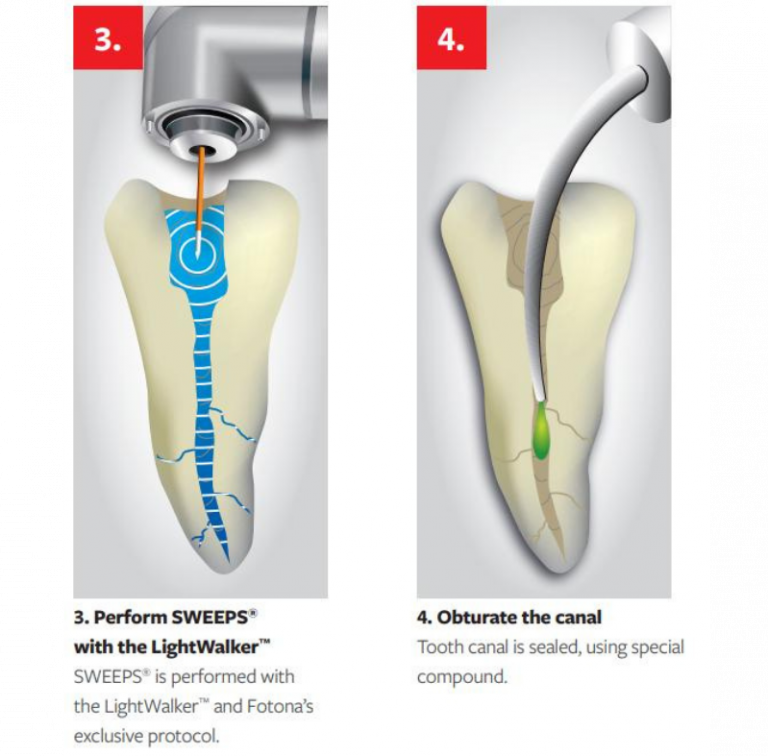
PIPS, short for Photon Induced Photoacoustic Streaming, and its more advanced successor SWEEPS, Shock Wave Enhanced Emission Photoacoustic Streaming, use short laser pulses to create shockwaves inside the irrigation solution already filling the canal. Those shockwaves drive the disinfectant into the accessory canals and lateral branches, reaching bacteria that mechanical instrumentation alone cannot reach. Clinical research consistently shows this method produces significantly more thorough disinfection of the canal system than conventional irrigation alone.
For straightforward root canals, traditional technique is often sufficient. For teeth with complex canal anatomy, previous failed root canals, or persistent infection, adding laser assisted disinfection to the protocol can be the difference between success and retreatment. We discuss the rationale with each patient at the time of treatment. Read the full guide on our laser root canal page, or start with the basics on our root canals page.
Benefits and limits of dental lasers
Used in the right cases, dental lasers offer real benefits:
- Less bleeding, since the laser cauterizes as it cuts
- Reduced swelling and faster healing
- Less need for injectable anesthetic in some soft tissue procedures
- More thorough disinfection of bacteria in periodontal pockets and root canals
- Reduced post operative pain and faster return to normal eating and activity
- A less invasive alternative to scalpel based periodontal surgery in select cases
They also have limits. Lasers are not the right tool for every procedure. They do not replace cavity removal with a drill in most cases, they cannot set crowns or place fillings, and they are not appropriate for advanced surgical work that needs direct scalpel access. Some of the marketing claims made in the industry overstate what dental lasers can do. We are honest about when a laser adds real value and when it does not.
Who benefits most from laser procedures
Patients who tend to benefit most include:
- Those with early to moderate periodontitis who want a less invasive treatment than scalpel surgery
- Patients recovering from prior periodontal treatment who need ongoing bacterial control
- Patients with complex root canal anatomy or previously failed root canal treatment
- Patients with anxiety around traditional surgical procedures who value faster recovery
- Patients on blood thinners where reduced bleeding during soft tissue procedures is clinically meaningful
- Patients looking for faster healing after oral surgery
We recommend laser treatment when there is a clear clinical reason for it. We will not upsell laser treatment as a default option just because the equipment is in the room.
Safety, training, and standards
The dental lasers we use are FDA cleared for their specific applications and we follow the manufacturer protocols and published clinical evidence for each indication. Everyone in the room wears wavelength specific protective eyewear during laser procedures. Energy settings, pulse timing, and delivery techniques are all calibrated to the specific procedure and patient. Dental laser therapy is a skilled technique that requires ongoing training, and our team has that training.
Cost and insurance
Pricing depends on the specific procedure. For periodontal laser therapy, the laser component is often an adjunct to traditional scaling and root planing or periodontal maintenance and the overall fee reflects the combined treatment. Insurance coverage generally follows the underlying procedure code. For laser assisted root canal treatment, the laser disinfection may be billed separately or bundled into the root canal fee, depending on the case. We walk through the expected cost and insurance coverage before any laser work begins.
See accepted insurance plans or request a consultation online.
FAQ
Frequently asked questions
Common questions about laser dentistry and its applications.
What is TwinLight laser treatment used for in dentistry?
TwinLight is a dual wavelength laser system from Fotona that combines two different laser wavelengths to address periodontal disease. One wavelength removes diseased soft tissue and kills bacteria in deep pockets, the other stimulates the underlying tissue to heal and regenerate. We use it as an adjunct to traditional scaling and root planing for moderate periodontitis and as a less invasive alternative to scalpel based pocket reduction surgery in certain cases. It is also used after oral surgery to speed healing.
Is laser dentistry less painful than traditional procedures?
For many soft tissue procedures, yes. Dental lasers cauterize as they cut, which means less bleeding, less swelling, and often reduced need for local anesthetic. Patients typically report less post operative discomfort than with scalpel based alternatives, and healing time is shorter for many procedures. That said, lasers are not a universal pain eliminator. For a routine scaling and root planing, you will still have local anesthetic. The comfort advantage is real but it is not magic.
Can laser therapy replace traditional gum surgery?
In some cases, yes. For early to moderate periodontitis, laser assisted periodontal therapy can provide many of the benefits of traditional flap surgery without the same level of invasiveness, recovery time, or post op discomfort. For advanced cases with significant bone loss or complex anatomy, traditional surgical techniques are still the right tool. We evaluate each case individually and recommend what gives you the best long term outcome, not what sounds most high tech.
How does laser assisted root canal treatment work?
PIPS SWEEPS, short for Photon Induced Photoacoustic Streaming and Shock Wave Enhanced Emission Photoacoustic Streaming, is a laser technique that uses short laser pulses to create shockwaves inside the cleaning solution already in the root canal system. Those shockwaves drive the disinfectant into the tiny accessory canals and lateral branches that traditional files and irrigation cannot easily reach. The result is a more thoroughly disinfected root canal system, which is often the difference between a successful root canal and a persistent infection.
Is laser dentistry safe?
Yes, when delivered by trained providers with appropriate equipment. The dental lasers we use are FDA cleared for the specific applications we use them for, and safety protocols include protective eyewear for everyone in the room, specific tissue handling techniques, and adherence to the recommended energy settings. We only use lasers where there is clear clinical evidence of benefit over traditional methods.
How much does laser dentistry cost?
Laser procedures vary in cost based on what is being treated. In many cases the laser component is an adjunct to a traditional procedure rather than a completely separate fee, and insurance coverage follows the underlying treatment. Some laser procedures reduce overall cost by shortening treatment time or eliminating follow up visits. We walk you through pricing and insurance coverage clearly before any laser work begins.
Get started
Curious whether laser dentistry is right for your case?
We use dental lasers where the evidence supports clinical benefit. A consultation will tell you honestly whether this technology is the right fit for you.